
Guides → Law & compliance
Hazardous IT waste: CRTs, batteries and the paperwork that changes
Most office IT is ordinary, non-hazardous electrical waste. A few things commonly found in the same cupboards aren't, and when hazardous items are in the load the paperwork, the retention period and the rules on mixing all change.
Why it matters which category you're in
Ordinary commercial waste moves on a waste transfer note, which you keep for two years. Hazardous waste in England and Wales moves on a consignment note under the Hazardous Waste Regulations 2005, and producers and holders must keep their copies for three years. The note records the hazardous properties of the waste and follows it all the way to the site that receives it.
There's also a rule against mixing. Hazardous waste mustn't be combined with non-hazardous waste, or with other categories of hazardous waste, without the right permit. A cage of laptops with a few old CRT monitors thrown on top is exactly the kind of load that causes problems.
Scotland runs a separate regime (special waste, regulated by SEPA), and Northern Ireland has its own regulations. The principles are the same, but the forms and some of the details differ.
The usual suspects in an IT clearance
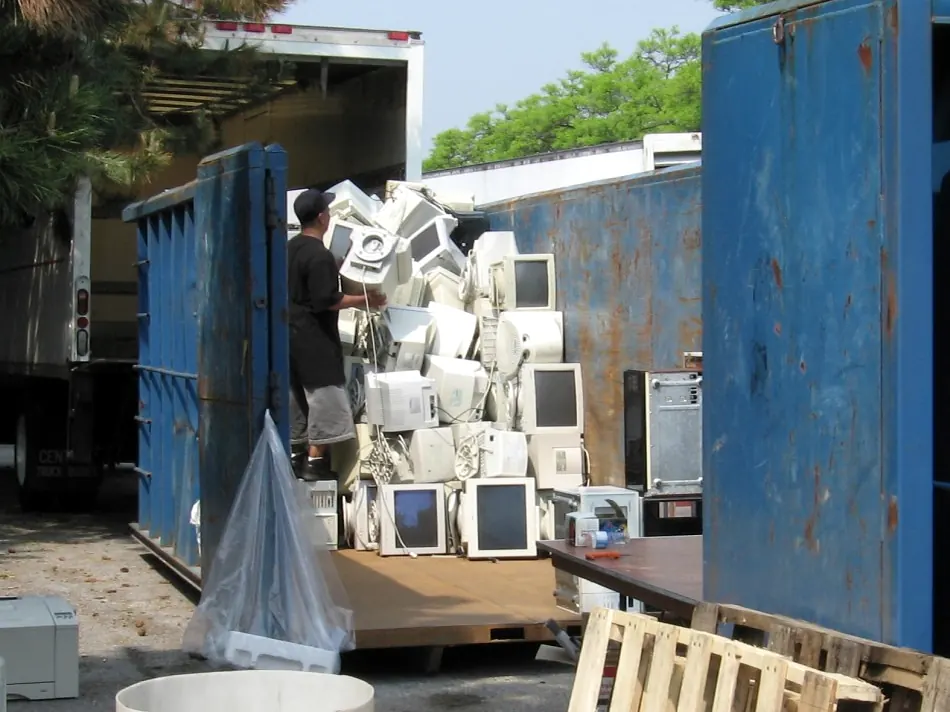
CRT monitors and televisions
The glass in cathode ray tubes contains a lot of lead, which puts them firmly in the hazardous category. They also tend to turn up in exactly the places a clearance reaches last, such as the back of a storeroom, a server room shelf or a school AV cupboard.
Older flat screens with CCFL backlights
Before LED backlighting became standard around the end of the 2000s, LCD monitors and laptop screens were lit by cold cathode fluorescent lamps, which contain mercury. Equipment with those components is normally classified as hazardous. Modern LED-backlit screens generally aren't.
UPS batteries
This one gets missed all the time. Uninterruptible power supplies in comms rooms and under desks usually contain sealed lead-acid batteries, and lead-acid batteries are hazardous waste. A clearance that includes a rack UPS almost certainly includes hazardous waste too.
Lithium batteries
Lithium-ion cells in laptops, phones and power banks aren't always classed as hazardous under waste classification, but they're a serious fire risk, especially when damaged or swollen, and they're regulated as dangerous goods for transport. Swollen laptop batteries should be flagged before collection so they can be packed separately. Never crush them or put them in a general waste bin.
Toner and ink
Most toner cartridges are non-hazardous, but some contain hazardous substances and are coded differently. Your carrier should classify them, and they shouldn't just go in with the general waste.
| Item | Typically | Why |
|---|---|---|
| CRT monitor | Hazardous | Leaded glass |
| LCD with CCFL backlight | Hazardous | Mercury lamps |
| UPS with lead-acid batteries | Hazardous | Lead and acid |
| Modern laptop, PC, server | Non-hazardous | Standard WEEE |
| LED-backlit monitor | Non-hazardous | Standard WEEE |
| Loose lithium batteries | Special handling | Fire risk, transport rules |
Classification depends on the specific item and its components. Your registered carrier is responsible for assigning the correct waste codes, and you should expect them to do so in writing.
What this means in practice
- Declare hazardous items when you book. Tell the carrier about CRTs, old flat screens and UPS units upfront so the right vehicle, packaging and paperwork turn up.
- Keep them separate on site. Don't let them get mixed into cages of standard IT.
- Expect two kinds of paperwork. A transfer note for the standard WEEE and a consignment note for the hazardous items. File the consignment notes for three years.
- Remember data still applies. A CRT monitor holds no data, but the old PC next to it does. Hazardous handling and data destruction are separate obligations.
- Expect a charge. Hazardous items cost more to process and have no resale value, so they're usually the one part of a clearance that isn't free. A good carrier will say so before the job, not after.
Premises registration
England dropped the requirement for hazardous waste producers to register their premises in 2016. Wales still requires registration for sites producing more than a threshold quantity each year. If you're a Welsh site, check the current position with Natural Resources Wales.
Old monitors or UPS units in the mix? Tell us when you enquire and we'll quote them separately and bring the right paperwork.
Get a quote